Thursday, 1 November 2012

Disney Voted One of the Top Facebook Posts of the Past Week


An insightful blog post by Nick Cicero of Social Fresh prompted us at Schrenk PR to discuss  one of the most engaging Facebook posts from last week. 


Facebook released its third quarter results last week, with news that they had reached 1 Billion users.  The research also showed nearly 58% of Facebook users are women and 18% post daily status updates. This means that there are more than 500 Million women active on Facebook every day.

“The consumer isn’t a moron. She is your wife.” ― David Ogilvy
 

So, how do you break through the clutter of Facebook?  As David Ogilvy said, (and he was talking about advertising – way before social media was even heard of), it takes more to persuade someone to buy something than a quick promotion, contest or  paid ads.  It’s the combination of creativity, information, and audience desire that make great content work or poor content look outdated and boring.  This holds true today with social media, and it’s still all about developing relationships.

Disney did it well this past week when they posted a photo of Thumper along with the modified maxim “If you can’t say something nice, don’t say nothing at all.”  There wasn’t a cute caption, nor a mention of what movie it came from, yet they racked up more than a quarter of a million likes and 80,000 shares in three days.

Disney knows the power of emotion and nostalgia in storytelling; it is what drives the stories they create for millions each year. Simply, they’re introducing a cherished character with a universally good message.  The visual emphasis is not about driving sales, rather they want their fans to align themselves with quality attributes that their favorite character (Disney brand) also shares.

It’s not difficult to see why it was voted one of the top posts of last week.  So, what can you do for your fans on Facebook to create this exclusivity within a status update?  Get creative and  break down those barriers.  Open up to your customers and share real value on your Facebook page.


Tuesday, 2 October 2012

Be Socially Savvy about Facebook “Likes” - Study Reveals What They Really Mean


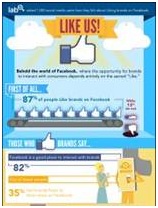
Today, marketers are scrambling to increase “likes” on Facebook, but a recent survey, by Lab 42 shows us what “like” really means.  Only 42% of Facebook users agree that marketers should interpret “like” to mean that they are a fan or advocate of the company.   The other 58% are either indecisive (33%) or disagree with the statement (25%).

A strong “take-away” from the survey is that 46% of the Facebook users wouldn’t buy a brand they “liked,” either because it was too expensive or it didn’t offer a discount or coupon.  Today’s savvy consumers are telling us that “like” is just the beginning of an online relationship.  Just because they click “like”, doesn’t necessarily mean they like the brand.  It might be because they’re helping a friend, they want a coupon or more information on the brand. Don’t over-sell, and be cautious not to clutter newsfeeds because “unlike” is just a click away.   

Not all “Likes” are Created Equal

The study shows that “like” means different things to different age groups.  It seems that younger consumers aged 15-24 tend to use “like” for purposes of self-expression and public endorsement for a brand. They consider it a worthwhile bonus if they get coupons or deals from a company because of their “like,” but accessing these deals is not their primary motivation. 

Consumers aged 25-34 are more likely to expect something of value in return for a “like”, and they are quick to “unlike” a company that doesn’t follow-up with discounts, product information, or exclusive offers. 
 
Finally, consumers in the 35-51 age group have the highest expectations, and it’s not just getting anything in return for liking a company.  They want something relevant and valuable, whether it’s information or discounts.  Moreover, individuals in this age bracket don’t hesitate to “unlike” a brand if it doesn’t live up to their expectations. 

So, now we know that 75% of respondents feel closer to a brand they “like” on Facebook, we also know that brands have to nurture these relationships to keep their value.  “Like” doesn’t mean marketers have permission for one-to-one marketing, instead, it represents consent to receive select marketing messages, while leaving the door ajar (or at least unlocked) for taking the relationship further.  Find out more on how social media affects a company’s PR efforts in our Schrenk PR’s next PR Bits & Bites blog post.

Sunday, 9 September 2012

Moms Online


A recent Nielsen infographic details "The Digital Lives of American Moms." Moms are generally at the “hub” of their family’s offline life, so it’s not surprising that they dictate several of the top trends online too.   They are looking up product reviews, catching up with friends and family, and connecting with brands on social networks.
Some intriguing statistics from the Nielsen survey:
·         50% of all moms actively participate in social media via mobile devices, compared to 37% of the general population.
·         Nearly one in three bloggers are moms.
·         Moms are 38 % more likely to become a fan of or follow a brand online.
·         Three out of four moms visited Facebook in March 2012
·         52% of bloggers are parents with kids under 18 in the household
The Nielsen infographic shows that nearly 40 percent of moms are likely to become a fan of or follow a brand online. Does your brand have a strong online presence?   By making sure that your business is visible and active online (with a strong mobile strategy, too) you can better tap into this forward-thinking group.
At Schrenk PR we are always chatting with mom bloggers, and find them engaging and important influencers. Today, it’s pretty much accepted that bloggers are integral in a media campaign, and that they contribute to a brand’s visibility and awareness. We’d love to talk to you about how we have worked with mom bloggers to build our clients’ brands in both Canada and the U.S.

Friday, 3 August 2012

Let Your Customers Tell the World How Great You Are!


I was reading a post recently that discussed “community”.  It talked about how community is part of your product and how it will improve your product.  This led to my thinking about the value of building a community for your brand, and the importance of listening to what’s being said about your company or product.

Why is building a community important?  What do you need to know about what’s being said?  

Today, when a consumer buys a product, or becomes a member of a website, they get access to a lot of knowledge about that product. When they become part of your community, they get something more. Now they’re part of something – part of a community.  In a world where connection is everything, we’ve somehow become less connected physically. However; we still need to feel connected and a community gives us that feeling.  We have the ability to chat with somebody, ask questions, and get help in real time. 

Is anybody listening?

When you can hear what customers are saying to each other, you get a candid look at what they like or don’t like.  This is invaluable input and better yet, it makes a company seem more real and caring. Think about it, a company that cares about what you think of their product makes you feel good and your user experience is enhanced. That’s an emotional connection to a product that is hard to replace.

Are you Listening?

An amazing story I’d like to share is one I read from the well-known Peter Shankman (author, entrepreneur, speaker, and worldwide connector; best known for founding Help A Reporter Out (HARO), and now Vice President and Small Business Evangelist for Vocus).  When boarding a plane from a whirlwind day trip, Peter sent out a “joke tweet” that ended up turning into “we really do listen”, and `the greatest customer service story ever told’. 


It went something like this:   


It was certainly a joke and he was completely flabbergasted at the result.


And sure enough, Twitter lit up like a bottle rocket.

He went on to say that today, “customer service isn’t about telling people how great you are. It’s about producing amazing moments in time, and letting those moments become the focal point of how amazing you are, told not by you, but by the customer who you thrilled. They tell their friends, and the trust level goes up at a factor of a thousand.”

So, what can we learn from Shankman’s experience?

Be aware of what people are saying about you. Respond accordingly. Perhaps most importantly, have a chain of command in place that actually lets you do things in real time. Remember, had Morton’s had to get permission to make this happen, and go through numerous channels for approval, there’s no way this would have worked.

If you have a minute take a look at the full scenario here,  The Greatest Customer Service Story Ever Told, Starring Morton’s Steakhouse.”

So…again, are you listening?

Facebook
Linked In

###