Tuesday, 2 October 2012

Be Socially Savvy about Facebook “Likes” - Study Reveals What They Really Mean


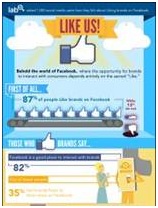
Today, marketers are scrambling to increase “likes” on Facebook, but a recent survey, by Lab 42 shows us what “like” really means.  Only 42% of Facebook users agree that marketers should interpret “like” to mean that they are a fan or advocate of the company.   The other 58% are either indecisive (33%) or disagree with the statement (25%).

A strong “take-away” from the survey is that 46% of the Facebook users wouldn’t buy a brand they “liked,” either because it was too expensive or it didn’t offer a discount or coupon.  Today’s savvy consumers are telling us that “like” is just the beginning of an online relationship.  Just because they click “like”, doesn’t necessarily mean they like the brand.  It might be because they’re helping a friend, they want a coupon or more information on the brand. Don’t over-sell, and be cautious not to clutter newsfeeds because “unlike” is just a click away.   

Not all “Likes” are Created Equal

The study shows that “like” means different things to different age groups.  It seems that younger consumers aged 15-24 tend to use “like” for purposes of self-expression and public endorsement for a brand. They consider it a worthwhile bonus if they get coupons or deals from a company because of their “like,” but accessing these deals is not their primary motivation. 

Consumers aged 25-34 are more likely to expect something of value in return for a “like”, and they are quick to “unlike” a company that doesn’t follow-up with discounts, product information, or exclusive offers. 
 
Finally, consumers in the 35-51 age group have the highest expectations, and it’s not just getting anything in return for liking a company.  They want something relevant and valuable, whether it’s information or discounts.  Moreover, individuals in this age bracket don’t hesitate to “unlike” a brand if it doesn’t live up to their expectations. 

So, now we know that 75% of respondents feel closer to a brand they “like” on Facebook, we also know that brands have to nurture these relationships to keep their value.  “Like” doesn’t mean marketers have permission for one-to-one marketing, instead, it represents consent to receive select marketing messages, while leaving the door ajar (or at least unlocked) for taking the relationship further.  Find out more on how social media affects a company’s PR efforts in our Schrenk PR’s next PR Bits & Bites blog post.

Sunday, 9 September 2012

Moms Online


A recent Nielsen infographic details "The Digital Lives of American Moms." Moms are generally at the “hub” of their family’s offline life, so it’s not surprising that they dictate several of the top trends online too.   They are looking up product reviews, catching up with friends and family, and connecting with brands on social networks.
Some intriguing statistics from the Nielsen survey:
·         50% of all moms actively participate in social media via mobile devices, compared to 37% of the general population.
·         Nearly one in three bloggers are moms.
·         Moms are 38 % more likely to become a fan of or follow a brand online.
·         Three out of four moms visited Facebook in March 2012
·         52% of bloggers are parents with kids under 18 in the household
The Nielsen infographic shows that nearly 40 percent of moms are likely to become a fan of or follow a brand online. Does your brand have a strong online presence?   By making sure that your business is visible and active online (with a strong mobile strategy, too) you can better tap into this forward-thinking group.
At Schrenk PR we are always chatting with mom bloggers, and find them engaging and important influencers. Today, it’s pretty much accepted that bloggers are integral in a media campaign, and that they contribute to a brand’s visibility and awareness. We’d love to talk to you about how we have worked with mom bloggers to build our clients’ brands in both Canada and the U.S.

Friday, 3 August 2012

Let Your Customers Tell the World How Great You Are!


I was reading a post recently that discussed “community”.  It talked about how community is part of your product and how it will improve your product.  This led to my thinking about the value of building a community for your brand, and the importance of listening to what’s being said about your company or product.

Why is building a community important?  What do you need to know about what’s being said?  

Today, when a consumer buys a product, or becomes a member of a website, they get access to a lot of knowledge about that product. When they become part of your community, they get something more. Now they’re part of something – part of a community.  In a world where connection is everything, we’ve somehow become less connected physically. However; we still need to feel connected and a community gives us that feeling.  We have the ability to chat with somebody, ask questions, and get help in real time. 

Is anybody listening?

When you can hear what customers are saying to each other, you get a candid look at what they like or don’t like.  This is invaluable input and better yet, it makes a company seem more real and caring. Think about it, a company that cares about what you think of their product makes you feel good and your user experience is enhanced. That’s an emotional connection to a product that is hard to replace.

Are you Listening?

An amazing story I’d like to share is one I read from the well-known Peter Shankman (author, entrepreneur, speaker, and worldwide connector; best known for founding Help A Reporter Out (HARO), and now Vice President and Small Business Evangelist for Vocus).  When boarding a plane from a whirlwind day trip, Peter sent out a “joke tweet” that ended up turning into “we really do listen”, and `the greatest customer service story ever told’. 


It went something like this:   


It was certainly a joke and he was completely flabbergasted at the result.


And sure enough, Twitter lit up like a bottle rocket.

He went on to say that today, “customer service isn’t about telling people how great you are. It’s about producing amazing moments in time, and letting those moments become the focal point of how amazing you are, told not by you, but by the customer who you thrilled. They tell their friends, and the trust level goes up at a factor of a thousand.”

So, what can we learn from Shankman’s experience?

Be aware of what people are saying about you. Respond accordingly. Perhaps most importantly, have a chain of command in place that actually lets you do things in real time. Remember, had Morton’s had to get permission to make this happen, and go through numerous channels for approval, there’s no way this would have worked.

If you have a minute take a look at the full scenario here,  The Greatest Customer Service Story Ever Told, Starring Morton’s Steakhouse.”

So…again, are you listening?

Facebook
Linked In

###

Friday, 6 July 2012

PR or Advertising ---- What’s the difference?


The roles of Advertising and Public Relations are often confused.  This can mean that Advertising is chosen when PR should have been or vice versa.  This can lead to unmet expectations and can be very frustrating both for the client and agency.    

To try and clear up some of this confusion, I wanted to talk to you about when you should use PR and when you should Advertise.

The answer, simply, is that it depends on your objective(s), and sometimes you need both.   

The main difference between PR and Advertising is how your message is controlled.  When you Advertise, you pay for what your ad says and how you want it to look.  You also choose whether the medium is broadcast (radio & TV), on-line, newspaper, magazine, billboards, bus/metro cards etc.   Simply put, you control everything except whether your target decides to buy your brand or not.  

In the case of PR, you also control your message by what you have written in your press release; however, you can’t control what the media decides to write about or even if they’ll write anything at all. If it looks too commercial or like a paid for advertorial – editors will perceive it as you, the client, looking for free advertising and your brand won’t be written about.  At Schrenk PR, we specialize in taking a brand’s message and creating a press release that’s angled to look like it belongs in the particular magazine or newspaper that we’re talking with, or will be of interest to a particular TV/Radio program or blogger.  

To decide what’s best for your brand, you have to think about what you want to achieve and what the comparative costs will be.  Do you want to build brand awareness/image and credibility to increase purchase intention, or do you want to build frequency to increase in-store traffic?  Once you’ve decided what your objective is, you need to look at costs.

With advertising you gain frequency of message for your brand.  With enough money you can dominate a medium with commercials and/or ads that will drive your message to your target consumer and they will buy your brand.  You have to remember though that ads are often perceived as self-serving, so your message is very important for your ad campaign to be effective.

On the other hand, PR gives the credibility of a third-party endorsement, the media.  This means that a particular Magazine/Blogger/Newspaper or Radio/TV interviewer, is talking/writing about your brand on their own initiative, and that is an enormously powerful tool in shaping public opinion.  Again, one article here and another article there, or a few bloggers writing about your brand won’t do much to build an image or create awareness for your brand.  At Schrenk PR we know how to execute a comprehensive PR campaign that will generate the articles, blog posts and/or TV & radio interviews to make it look like the various medias are endorsing your brand.  This is critical when building brand image, awareness and purchase intention. 

PR gives your brand message credibility and Advertising gives your brand frequency of message.

For small companies, PR is the better choice to communicate to a specific target audience.  For larger companies with a sufficient budget, a combination of Advertising and PR will ensure that your brand message is both credible and remembered.

As Advertising Age says, PR is the nail and Advertising is the hammer!

Facebook
Linked In
###